

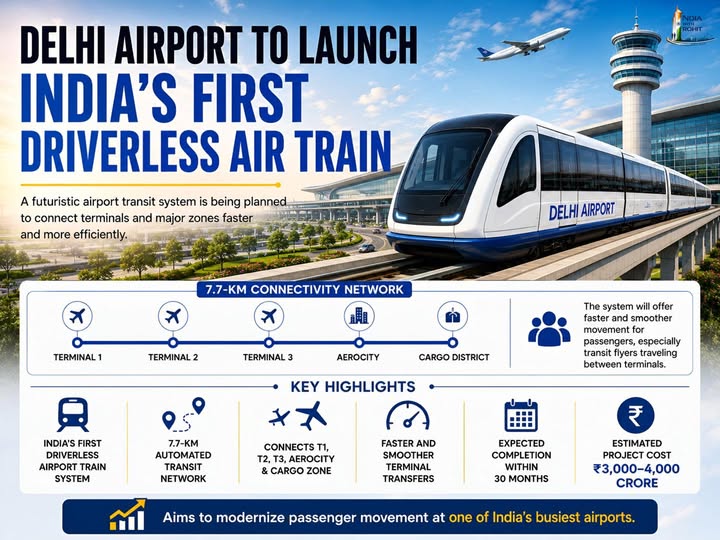
Delhi Airport Set to Launch India’s First Driverless Air Train: A Major Leap for Smart Airport Infrastructure
India’s aviation sector is preparing for a transformative infrastructure upgrade as Delhi’s Indira Gandhi International Airport (IGIA) moves ahead with plans to introduce the country’s first driverless Air Train system. The ambitious project, which will function as an Automated People Mover (APM), is expected to redefine passenger mobility inside one of the busiest airports in Asia. Designed to seamlessly connect terminals, Aerocity, and cargo zones, the upcoming driverless transit system represents a significant step toward building smarter, faster, and globally competitive airport infrastructure in India.
The proposed Air Train corridor will span approximately 7.7 kilometers and connect Terminal 1, Terminal 2, Terminal 3, Aerocity, and Cargo City through a fully automated and driverless network. The project is being developed by Delhi International Airport Limited (DIAL), which operates IGIA. Estimated to cost between ₹3,000 crore and ₹4,000 crore, the Air Train is expected to become one of the most advanced airport mobility projects ever undertaken in the country. According to reports, construction could begin after the final approval process, with operations likely to start between 2027 and 2029.
Delhi Airport has witnessed tremendous growth over the past decade, handling millions of domestic and international passengers every year. With increasing passenger traffic, the need for faster inter-terminal transportation has become critical. Currently, passengers often depend on shuttle buses, cabs, or long walking routes to move between terminals, especially during peak travel hours. The Air Train project aims to solve this challenge by offering a rapid, efficient, and sustainable transport solution within the airport ecosystem.
The driverless Air Train will operate using automated electric transit technology commonly seen at major international airports such as Dubai International Airport, Singapore Changi Airport, Heathrow Airport in London, and several airports in the United States and Europe. These systems are known for reducing travel time, improving operational efficiency, and enhancing passenger comfort. By introducing a similar system, Delhi Airport is aligning itself with global aviation standards and strengthening its position as an international aviation hub.