

India’s Global Diplomacy Powering Economic Growth, Technology Expansion and Global Industrial Leadership
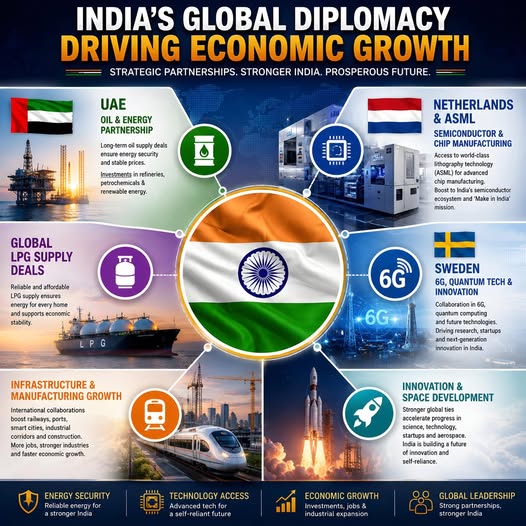
India is rapidly transforming into one of the world’s most influential economic powers, and global diplomacy has become one of the biggest driving forces behind this transformation. Over the past few years, India has strategically strengthened partnerships with countries such as the United Arab Emirates, the Netherlands, and Sweden to secure energy resources, boost semiconductor manufacturing, accelerate innovation, and strengthen infrastructure development. These diplomatic relationships are not limited to political cooperation; they are directly contributing to industrial growth, foreign investment, manufacturing expansion, digital transformation, and technological advancement across the country. As the global economy becomes increasingly competitive and interconnected, India’s international partnerships are helping the nation build a strong and future-ready economy capable of competing with the world’s largest economic powers. Through long-term collaborations in energy, technology, and industrial development, India is steadily positioning itself as a global manufacturing and innovation hub.
One of the strongest pillars of India’s global diplomacy is energy security, especially through its growing partnership with the United Arab Emirates. India is one of the world’s largest energy consumers, and maintaining a stable supply of oil and gas is essential for supporting industries, transportation, manufacturing, and infrastructure projects. Long-term agreements with the UAE are helping India secure reliable energy supplies while reducing risks linked to global fuel price fluctuations and geopolitical uncertainties. The partnership has also expanded into petrochemicals, renewable energy projects, logistics infrastructure, and refinery investments, creating new economic opportunities and improving industrial productivity. Alongside the UAE partnership, global LPG supply agreements are ensuring affordable cooking fuel access for millions of Indian households, especially in rural and semi-urban areas. These international energy collaborations are strengthening India’s economic resilience while supporting social welfare and long-term industrial stability. Stable energy access remains critical for sustaining India’s rapid urbanization, industrial growth, and expanding manufacturing sector.
India’s collaboration with the Netherlands and semiconductor giant ASML is another major step toward technological self-reliance and advanced manufacturing growth. Semiconductors are the backbone of modern technology, powering smartphones, computers, automobiles, artificial intelligence systems, medical equipment, and defense infrastructure. Global chip shortages in recent years highlighted the importance of building strong domestic semiconductor capabilities, and India is now aggressively investing in this sector. Through partnerships with the Netherlands and ASML, India aims to strengthen its semiconductor ecosystem, attract global technology investments, and support domestic electronics manufacturing under the “Make in India” initiative. These collaborations are expected to help India reduce dependence on imported chips while creating high-skilled jobs and improving industrial competitiveness. At the same time, India’s partnership with Sweden is driving innovation in 6G telecommunications, artificial intelligence, quantum computing, and advanced digital infrastructure. Sweden’s expertise in telecom and innovation ecosystems is helping India prepare for the future of next-generation connectivity and smart technologies. These international collaborations are positioning India as an emerging global leader in technology and digital transformation.
Infrastructure modernization and manufacturing expansion are also receiving major support through India’s strategic global partnerships. Foreign investments and international collaborations are helping accelerate the development of railways, smart cities, industrial corridors, highways, ports, airports, and logistics hubs across the country. Infrastructure growth is essential for improving supply chains, reducing transportation costs, increasing exports, and attracting large-scale industrial investments. At the same time, India is becoming a preferred manufacturing destination for global companies looking to diversify operations and strengthen supply chain resilience. Government initiatives such as Production Linked Incentive schemes and “Make in India” are encouraging multinational corporations to establish factories and production units in sectors including electronics, automobiles, renewable energy, defense manufacturing, aerospace, and telecommunications. India’s diplomatic strategy is also helping strengthen innovation ecosystems, startup growth, scientific research, and space technology development. Through global partnerships, Indian companies and startups are gaining access to international funding, advanced technologies, and global research networks, further accelerating economic modernization and industrial growth.