

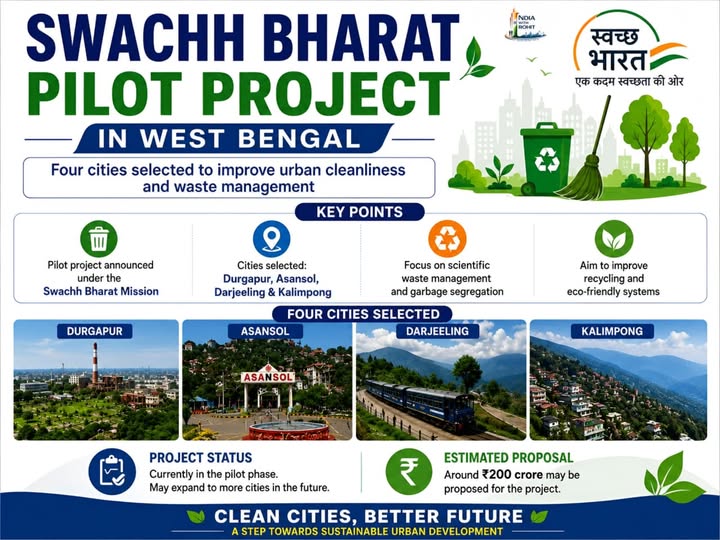
Swachh Bharat Pilot Project in West Bengal: A Major Step Towards Scientific Waste Management and Sustainable Urban Development
The Government of India’s Swachh Bharat Mission has taken another significant step toward improving urban cleanliness and sustainable waste management through the launch of a pilot project in West Bengal. The initiative focuses on strengthening scientific waste disposal systems, promoting garbage segregation, and creating cleaner and greener urban spaces. Under this project, four important cities of West Bengal — Durgapur, Asansol, Darjeeling, and Kalimpong — have been selected for the pilot phase. These cities were chosen due to their growing urban population, increasing waste generation, and the urgent need for better waste management infrastructure. The project aims to modernize the existing sanitation systems and encourage eco-friendly practices among citizens. With rapid urbanization becoming a major challenge in India, this pilot project is expected to serve as a model for other cities across the country. Authorities believe that effective waste segregation, recycling, and disposal systems can significantly reduce pollution and improve public health standards. The initiative also aligns with the broader vision of making Indian cities cleaner, healthier, and environmentally sustainable under the Swachh Bharat Mission.
The selected cities represent diverse geographical and urban conditions, making the project highly important for testing innovative waste management strategies. Durgapur and Asansol are industrial cities where increasing industrial and household waste has become a major environmental concern. Darjeeling and Kalimpong, on the other hand, are hill stations and popular tourist destinations that face unique challenges related to waste disposal due to difficult terrain and rising tourist footfall. By including both industrial and tourism-driven cities, the government aims to create customized waste management solutions suitable for different urban environments. Officials have highlighted that the pilot project will focus on scientific methods of garbage segregation at the source, improved waste collection mechanisms, and better recycling systems. The introduction of separate bins for biodegradable and non-biodegradable waste is expected to play a key role in reducing landfill pressure. Awareness campaigns will also be conducted to educate residents about responsible waste disposal practices and the importance of maintaining clean surroundings. Experts believe that public participation will be crucial for the success of the project, as citizen involvement can greatly improve recycling efficiency and reduce environmental damage caused by improper waste dumping.
Authorities are planning to introduce advanced recycling systems, composting facilities, and scientific landfill management techniques to handle urban waste more effectively. Reports suggest that nearly ₹200 crore may be proposed for the implementation of the project, reflecting the government's commitment to improving sanitation infrastructure in the state. The funding will likely be used for upgrading waste treatment plants, purchasing modern waste collection vehicles, and setting up waste segregation centers. The project is also expected to generate employment opportunities in the sanitation and recycling sectors. Local municipal bodies will play a major role in implementing and monitoring the project in collaboration with environmental experts and urban planners. Additionally, digital monitoring systems may be introduced to track waste collection and disposal efficiency in real time. Such technological integration can help authorities identify problem areas quickly and ensure smooth operations. Environmentalists have welcomed the initiative, stating that scientific waste management is essential for reducing pollution levels and protecting natural ecosystems, especially in ecologically sensitive areas like Darjeeling and Kalimpong.
The pilot project also carries significant social and economic benefit f~+h~ l ~f nt Bengal. Cleaner urba Back up now y of life for residents by reaucny nea isks assuciated with unmanaged waste, such as water contamination, air pollution, and the spread of diseases. Improved sanitation facilities are likely to enhance the overall urban environment, making cities more attractive for tourism and investment. For hill towns like Darjeeling and Kalimpong, better waste management can protect the natural beauty of the region, which is essential for sustaining tourism-based economies. In industrial cities such as Durgapur and Asansol, effective waste disposal systems can contribute to a healthier living environment for workers and local communities. The project also promotes environmental awareness among citizens, encouraging long-term behavioral changes regarding waste segregation and recycling. Schools, colleges, and local organizations may participate in awareness drives to promote cleanliness and environmental responsibility. Urban development experts believe that if the pilot phase proves successful, the initiative could be expanded to additional cities across West Bengal and eventually become a nationwide urban sanitation model. The success of the project could demonstrate how coordinated efforts between government agencies, local authorities, and citizens can create sustainable urban ecosystems.