

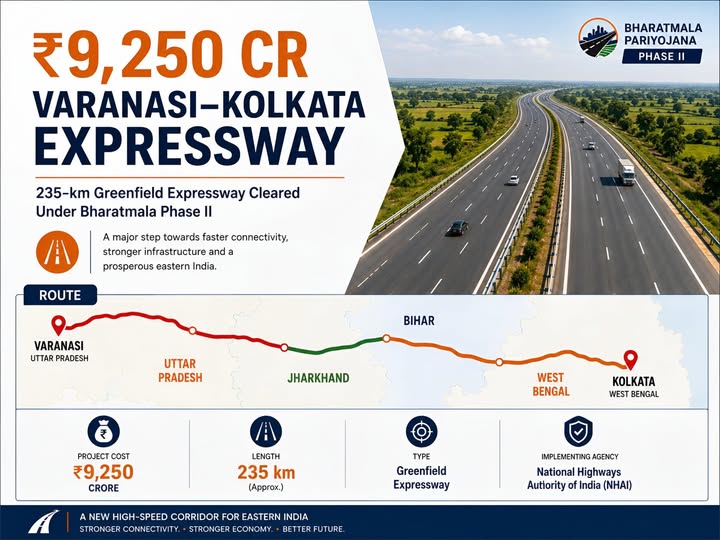
₹9,250 Cr Varanasi–Kolkata Expressway To Transform Eastern India’s Connectivity
The Government of India has cleared a major infrastructure project under the Bharatmala Pariyojana Phase II initiative — the ₹9,250 crore Varanasi–Kolkata Greenfield Expressway. The ambitious expressway project is expected to significantly improve road connectivity between eastern and northern India while boosting trade, logistics, and regional economic development. Stretching across multiple states including Uttar Pradesh, Jharkhand, Bihar, and West Bengal, the high-speed corridor will become one of the most important transport routes in eastern India. The Environment Ministry’s clearance for the 235-km section marks a crucial step toward the project’s implementation and reflects the government’s continued focus on expanding India’s highway infrastructure network.
The Varanasi–Kolkata Expressway is designed as a greenfield corridor, meaning it will be built on a completely new route instead of upgrading existing roads. This allows for smoother traffic flow, faster travel, and modern infrastructure planning. Once completed, the expressway is expected to reduce travel time between Varanasi and Kolkata considerably, making passenger and freight movement more efficient. The route will pass through strategically important regions in Uttar Pradesh, Jharkhand, Bihar, and West Bengal, connecting industrial zones, agricultural regions, and commercial hubs. Authorities believe the expressway will strengthen logistics chains and support the rapid transportation of goods across eastern India. Improved connectivity is also expected to attract industries, warehouses, logistics parks, and new investment opportunities along the corridor.
Infrastructure experts consider the project a major milestone under Bharatmala Phase II, the central government’s flagship highway development program aimed at modernizing India’s road network. The National Highways Authority of India (NHAI) will play a key role in implementing the project. The expressway is expected to generate thousands of direct and indirect employment opportunities during construction and after completion. Local businesses, transport companies, tourism operators, and small enterprises located near the route may benefit from increased economic activity. Better roads will also improve access to healthcare, education, and markets for rural communities situated around the expressway corridor. In addition, the project is expected to reduce traffic congestion on existing highways while improving overall road safety standards through modern engineering and traffic management systems.
West Bengal is likely to gain major economic and infrastructural advantages from the project. Improved road connectivity with northern and central India could strengthen Kolkata’s position as a key logistics and commercial gateway for eastern India. Faster cargo movement to ports and industrial centers may support trade growth and export activities. The expressway may also encourage real estate development, industrial expansion, and tourism growth in surrounding districts. Experts believe the project aligns with India’s long-term infrastructure modernization goals and could become a major catalyst for regional economic integration. The use of modern highway technology, efficient route planning, and better transport systems will help create a stronger and more connected eastern India corridor over the coming years.