

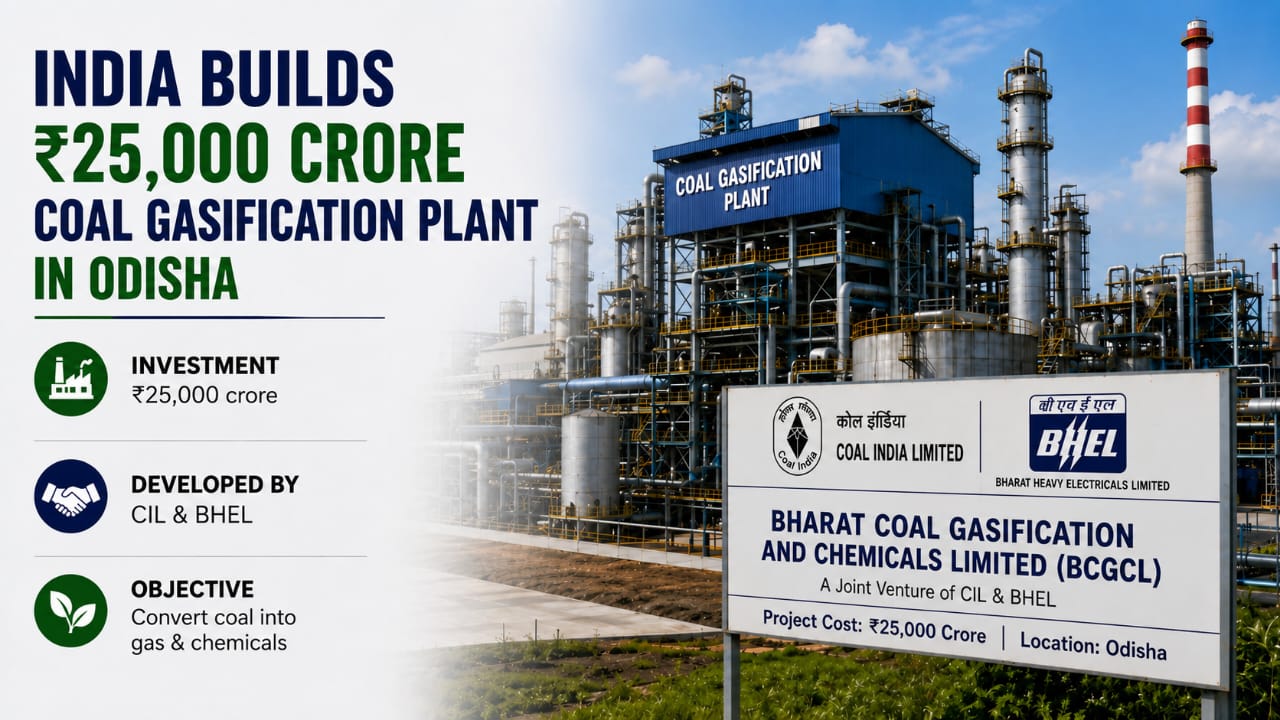
India Builds ₹25,000 Crore Coal Gasification Plant In Odisha
India has taken a major step towards strengthening its energy and chemical manufacturing sector with the launch of a ₹25,016 crore coal gasification project at Lakhanpur in Odisha's Jharsuguda district. The project, being developed by Bharat Coal Gasification & Chemicals Limited (BCGCL)—a joint venture between Coal India Limited (CIL) and Bharat Heavy Electricals Limited (BHEL)—will be India's first commercial-scale coal-to-ammonium nitrate facility using indigenous coal gasification technology.
The plant will convert domestic coal into synthetic gas (syngas), which will then be processed to manufacture ammonium nitrate, a key industrial chemical widely used in mining, infrastructure, and civil engineering. The facility is designed to produce around 2,000 tonnes of ammonium nitrate per day, reducing India's dependence on imported chemicals while creating greater value from the country's abundant coal reserves.
The project forms part of the Government of India's National Coal Gasification Mission, which aims to gasify 100 million tonnes of coal by 2030. By promoting cleaner utilisation of coal instead of direct combustion, the initiative seeks to improve energy security, support import substitution, and encourage the development of downstream chemical and fertiliser industries.
Apart from boosting industrial production, the project is expected to generate thousands of direct and indirect employment opportunities in Odisha while accelerating infrastructure development in the coal-rich Jharsuguda region. The use of indigenous Pressurised Fluidised Bed Gasification (PFBG) technology developed by BHEL also highlights India's growing capabilities in advanced industrial engineering and supports the Atmanirbhar Bharat initiative.
Once operational, the ₹25,000 crore facility will become one of India's largest coal gasification-based chemical complexes. It is expected to play a crucial role in strengthening the country's industrial self-reliance, reducing import dependence on fertilisers and industrial chemicals, and supporting India's long-term vision of sustainable resource utilisation and manufacturing-led economic growth.