

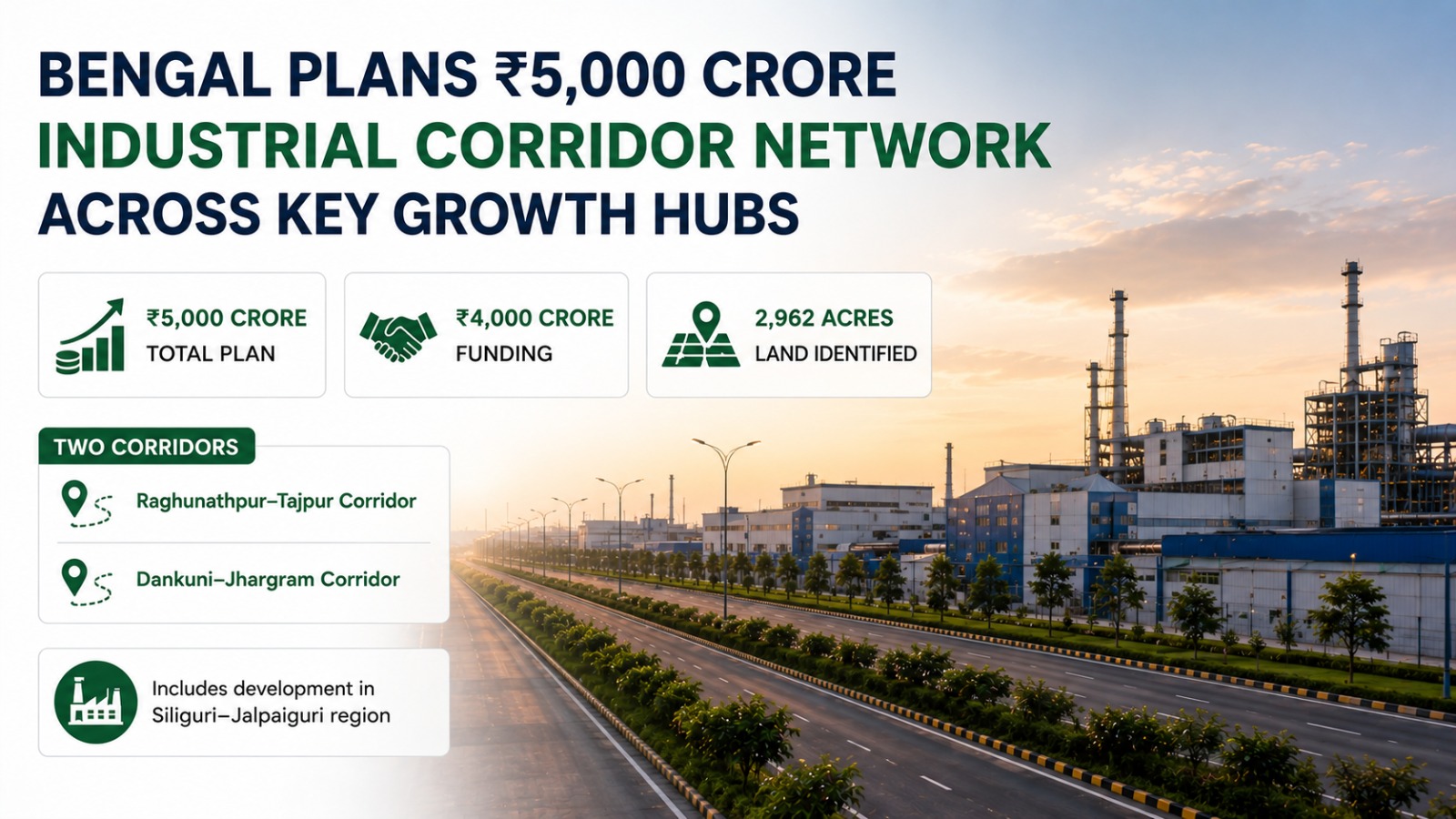
Bengal Plans ₹5,000 Crore Industrial Corridor Network Across Key Growth Hubs
The West Bengal government is planning to develop a ₹5,000 crore industrial corridor network connecting several of the state's key economic and manufacturing hubs, with the objective of accelerating industrial growth, improving logistics efficiency, and attracting large-scale domestic and global investments. The proposed corridors are expected to integrate industrial parks, logistics hubs, ports, highways, rail connectivity, and urban infrastructure, creating a seamless ecosystem for manufacturing and trade across the state.
The ambitious plan will focus on strengthening connectivity between major industrial regions such as Kolkata, Howrah, Durgapur, Asansol, Kharagpur, Haldia, Dankuni, and other emerging manufacturing clusters. By improving transport infrastructure and reducing logistics costs, the government aims to make West Bengal a more competitive destination for industries including engineering, steel, chemicals, automobiles, electronics, food processing, textiles, and logistics. The corridors are also expected to support the expansion of MSMEs while encouraging new industrial townships and warehousing facilities.
A significant portion of the investment will be directed towards developing high-quality road infrastructure, multimodal logistics parks, freight terminals, utility networks, and smart industrial infrastructure. The project is expected to leverage West Bengal's strategic location as the gateway to Northeast India, Bangladesh, Nepal, Bhutan, and Southeast Asian markets. Enhanced connectivity with ports, airports, railway freight corridors, and national highways will further strengthen the state's role in regional and international trade.
Officials believe the industrial corridor network will generate substantial employment opportunities by attracting private investments across multiple sectors. Alongside direct jobs in manufacturing and infrastructure development, the project is expected to create thousands of indirect employment opportunities in construction, logistics, transportation, warehousing, hospitality, and ancillary industries. The improved industrial ecosystem could also encourage multinational companies and Global Capability Centres (GCCs) to establish operations in the state.
If implemented successfully, the ₹5,000 crore industrial corridor network has the potential to transform West Bengal's industrial landscape over the coming decade. By creating world-class infrastructure, improving ease of doing business, and enhancing regional connectivity, the initiative is expected to position the state as one of eastern India's leading manufacturing and logistics destinations while supporting long-term economic growth, exports, and sustainable industrial development.