

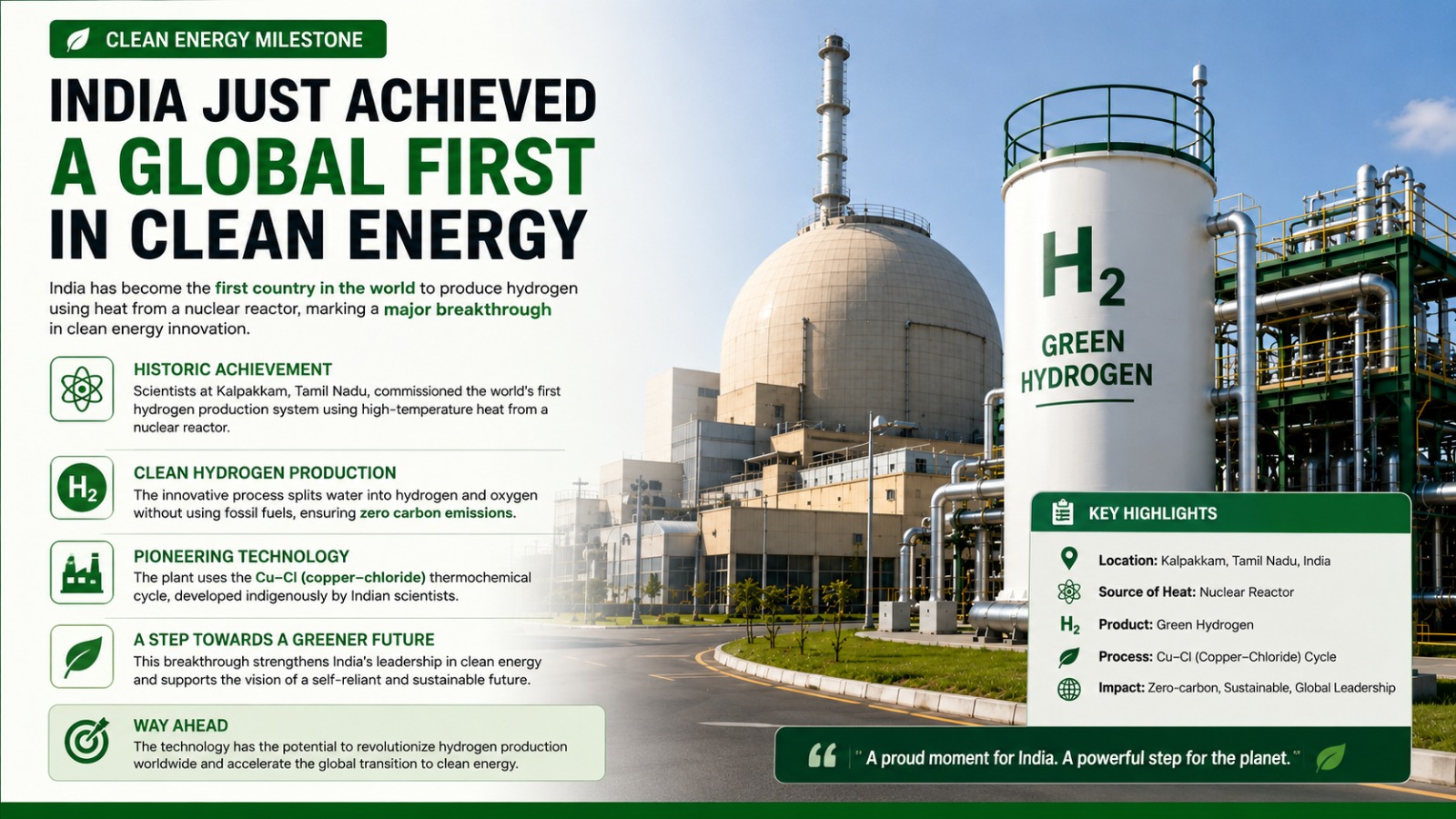
India Just Achieved A Global First In Clean Energy
India has achieved a global first in clean energy by commissioning the world's first hydrogen production facility that uses heat from a nuclear reactor instead of electricity to generate hydrogen. The pioneering pilot plant has been established at the Indira Gandhi Centre for Atomic Research (IGCAR) in Kalpakkam, Tamil Nadu, marking a major breakthrough in sustainable hydrogen production and expanding the role of nuclear energy beyond electricity generation.
The facility uses the Copper–Chlorine (Cu–Cl) thermochemical cycle, an advanced process developed by the Bhabha Atomic Research Centre (BARC). Instead of relying on electricity-intensive electrolysis, the plant harnesses process heat from the Fast Breeder Test Reactor (FBTR) to split water into hydrogen and oxygen. This approach improves efficiency while significantly reducing carbon emissions, making hydrogen production cleaner and more energy-efficient.
The project serves as a technology demonstrator, proving that nuclear process heat can be successfully integrated with hydrogen production. Scientists believe the breakthrough could pave the way for large-scale production of low-carbon "pink hydrogen", offering a reliable source of clean fuel for industries such as steel, chemicals, fertilizers, heavy transport, and power generation.
The innovation also strengthens India's ambitions under the National Green Hydrogen Mission by diversifying hydrogen production technologies. Unlike renewable-powered electrolysis, nuclear-powered hydrogen production can operate continuously, providing round-the-clock clean hydrogen without depending on weather conditions. This could play a vital role in reducing fossil fuel dependence, improving energy security, and accelerating industrial decarbonisation.
With this milestone, India has positioned itself at the forefront of next-generation clean energy technologies. The successful commissioning of the world's first nuclear heat-based hydrogen production facility highlights the country's growing capabilities in advanced nuclear research, clean fuel innovation, and sustainable energy development. As the technology matures, it could become a model for future hydrogen production systems worldwide, reinforcing India's leadership in the global transition toward a low-carbon economy.